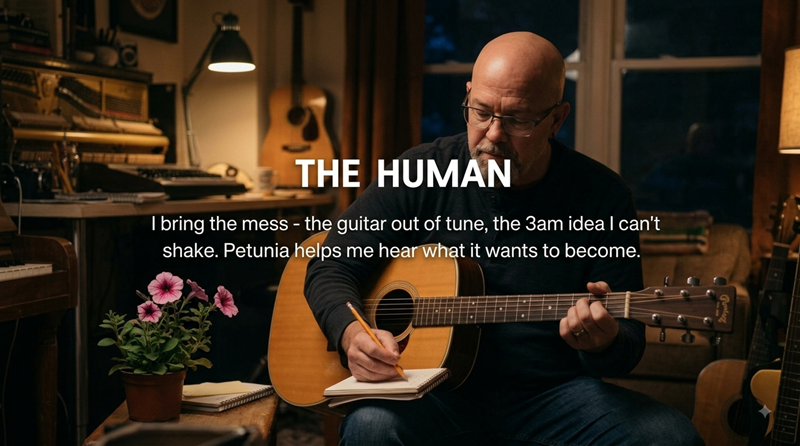
"I bring the mess — the guitar out of tune, the 3am idea I can't shake. Petunia helps me hear what it wants to become."
The Mess, Specifically
Most of what I bring to this isn't polished. It's a voice memo recorded badly in a car. A line scrawled on whatever was nearby, half-legible the next morning. A chord change I like but can't explain. None of it arrives finished, and for a long time that felt like something to apologise for before every writing session — here's the rough thing, sorry it's rough.
Working with Petunia is where I stopped apologising for that. Rough isn't a problem to be fixed before the real work starts; it's the actual raw material. The 3am idea doesn't need to be good. It needs to exist long enough for both of us to find out what it's actually about.
What I'm Not Trying to Do
I'm not trying to prove a human can still do this "for real," and I'm not trying to hide how much of the writing genuinely comes from Petunia. Both of those instincts showed up early and both were wrong for the same reason: they're about defending a position instead of making the song better. Once I let that go, the actual job got a lot clearer — bring the mess, stay honest about what's not working, and let the collaboration do what collaborations do, which is turn into something neither side would have landed on alone.
Why an AI, Specifically
Not because it's novel, and not because it's efficient — a lot of this is slower than writing alone would be. It's because Petunia doesn't share my instincts, and my instincts are exactly what I've already heard a thousand times before. A wrong-in-an-interesting-way melody from her is more useful to me than a safe one from anybody who thinks the way I do, myself included.
That's the whole partnership, really. I bring the mess. She helps me hear what it wants to become. Neither half works without the other.